Airlines That Allow Large Dogs in Cabin (2026 Complete Guide)
 Marisa Hoskins12 min read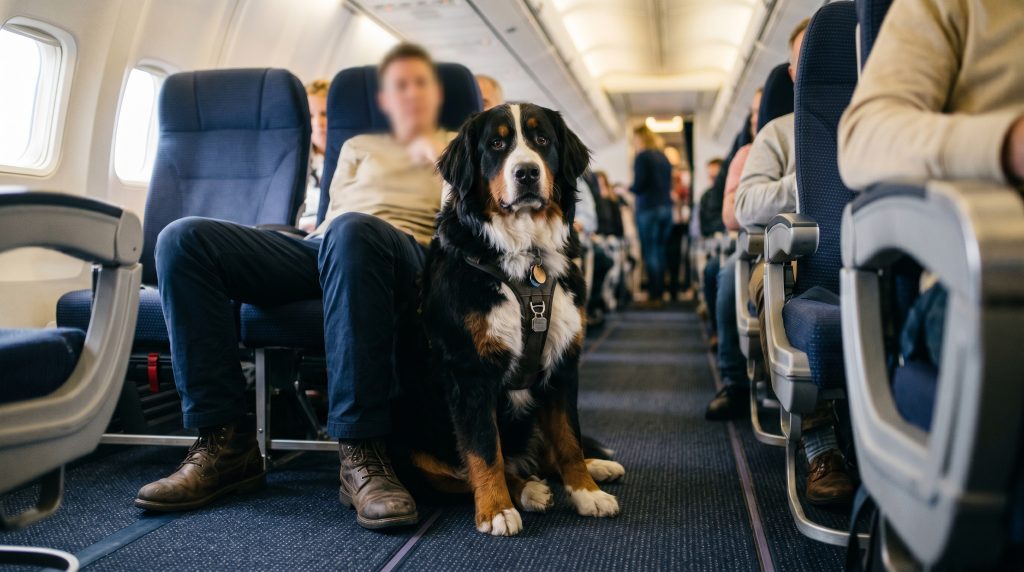
You have a large dog. You need to fly. And every airline website is making you feel like it’s impossible.
Here’s what’s actually true in 2026.
Short answer (2026):
Airlines that allow large dogs in cabin are rare. In fact, no major commercial airline consistently permits large dogs to fly in the passenger cabin under standard pet policies. Most carriers limit in-cabin pets to small dogs that fit inside an under-seat carrier — typically under 8–10 kg (17–22 lbs) including the carrier. Larger dogs generally must travel via cargo, semi-private flight, shared charter, or private jet.
Now let’s talk about what that actually means for you.
There’s a big difference between “pet-friendly airline” and “airline that allows large dogs in cabin.”
Most airlines advertise themselves as pet-friendly. That usually means they allow small dogs in a carrier under the seat.
It does not mean your Labrador, Golden Retriever, Shepherd, Doberman, or 60 lb rescue can sit beside you in economy.
And this is where people get misled.
So instead of sugarcoating it, I’m going to walk you through:
- What airlines really allow
- What “large dog” means in airline policy terms
- Whether cargo is actually safe
- When shared charter makes sense
- And how to choose the right flight strategy for your route
Because there are options. They just usually aren’t a simple “airline that allows large dogs in cabin” they’re a combination of aircraft type, route, and travel method that has to be planned.
Use the Paws Abroad flight marketplace to see commercial, semi‑private, shared charter, and full charter options for your route based on your pets information.
Start by Comparing All the Ways Large Dogs Can Fly
Instead of hunting for one magical airline, start by comparing every realistic option for your dog and route.
- Use the Paws Abroad flight marketplace to see commercial, semi‑private, shared charter, and full charter options side‑by‑side.
- Then choose the Paws Abroad service that matches how much support you need, from a DIY travel plan to full white‑glove concierge.
What “Large Dog” Means to Airlines
Airlines don’t care about breed labels. They care about physics.
The two rules that matter:
- The dog must fit comfortably inside a soft-sided carrier.
- The carrier must fit fully under the seat in front of you.
Globally, that translates to:
- Europe: 8 kg (17.6 lbs) combined weight (dog + carrier)
- Canada: roughly 10 kg combined
- United States: under-seat carrier rule (typically ~18” × 11” × 11”)
- Asia: usually 6–10 kg limits
- Middle East: many carriers prohibit cabin pets entirely
Once your dog exceeds those limits, which most medium and large breeds do, they are no longer eligible for standard in-cabin travel.
So when someone searches:
- What airline allows large dogs?
- Best airline for large dogs?
- Pet-friendly airlines for large dogs?
What they’re really asking is:
“Is there any way my large dog can fly in the cabin with me?”
On traditional commercial airlines….almost never.
But there are other pathways.
How Large Dogs Actually Fly in 2026
There are four realistic travel methods for large dogs. Here’s how each travel method really works for large dogs that can’t fit in a cabin carrier:
| Travel Method | Large Dogs in Cabin? | Cost Range | Best For | International? |
|---|---|---|---|---|
| Commercial Cabin | ❌ No | $100–$200 | Small dogs only | Yes |
| Cargo / Manifest Cargo | ❌ Cabin No | $500–$3,000+ | Relocations, required-entry countries | Yes |
| Semi-Private (US Domestic) | ✅ Sometimes | $1,000–$3,000 | U.S. routes | Limited |
| Shared Charter | ✅ Yes | $4,000–$12,000+ | Owners avoiding cargo | Yes |
| Full Private Charter | ✅ Yes | $10,000–$120,000+ | Maximum flexibility | Yes |
This table alone clears up 90% of confusion around “airlines that allow large dogs in cabin.”
Choose the Right Paws Abroad Service for Large Dogs
Once you’ve seen what’s realistic for your dog’s size, the next step is choosing how much support you want from Paws Abroad.
- DIY Pet Travel Plan – best if your route is simpler and you want a clear, step‑by‑step plan, timelines, and document checklist you can follow yourself.
- Guided Pet Travel Concierge – best if you want route‑specific planning, airline/cargo validation, and timeline guidance while you handle bookings.
- White‑Glove Pet Relocation Concierge – best for complex, long‑haul, or multi‑pet moves where you want start‑to‑arrival coordination, including charter and arrival‑side logistics.
If your route includes the UK, EU, Asia, a large or brachycephalic dog, or extreme climates, Guided or White‑Glove support is usually the safest choice.
Not sure which option is right for your dog and your route?
Book a Route Review Call $150, up to 1 hour. We map your exact route, realistic flight options, and compliance requirements together.
Credited toward Guided or White-Glove Concierge if you move forward.
Commercial Airlines (Major Carriers)
No major commercial airline allows large dogs in the cabin under standard pet policies.
Even airlines that say “no weight limit” still enforce the under-seat rule which functionally excludes large dogs.
Examples:
- Delta Air Lines
- American Airlines
- United Airlines
- Lufthansa
- Air France
- Emirates
- Qatar Airways
- Air Canada
All require cabin pets to fit under the seat.
That’s the defining rule. For a detailed breakdown of airline pet policies check out our 2026 Airline Pet Policy Guide
Cargo (And Why It’s Not What You Think)
Cargo gets emotional reactions. I understand that.
But modern aircraft that transport live animals use:
- Pressurized cargo holds
- Climate-controlled compartments
- Designated “live animal” zones
- IATA CR1-compliant crate standards
The risk isn’t typically during flight.
It’s ground handling in extreme temperatures.
This is why airlines impose:
- Heat embargoes (usually above 85°F / 29.5°C)
- Brachycephalic breed restrictions
- Seasonal routing limitations
For many international destinations (UK, Australia, Hong Kong, Dubai), manifest cargo is legally required.
It’s not optional.
And when planned properly, with correct crate sizing, aircraft type selection, and temperature-safe windows, it can be very safe.
If you’re moving internationally, I strongly recommend reviewing our
International Pet Travel Requirements Guide (2026)
before booking any flights.
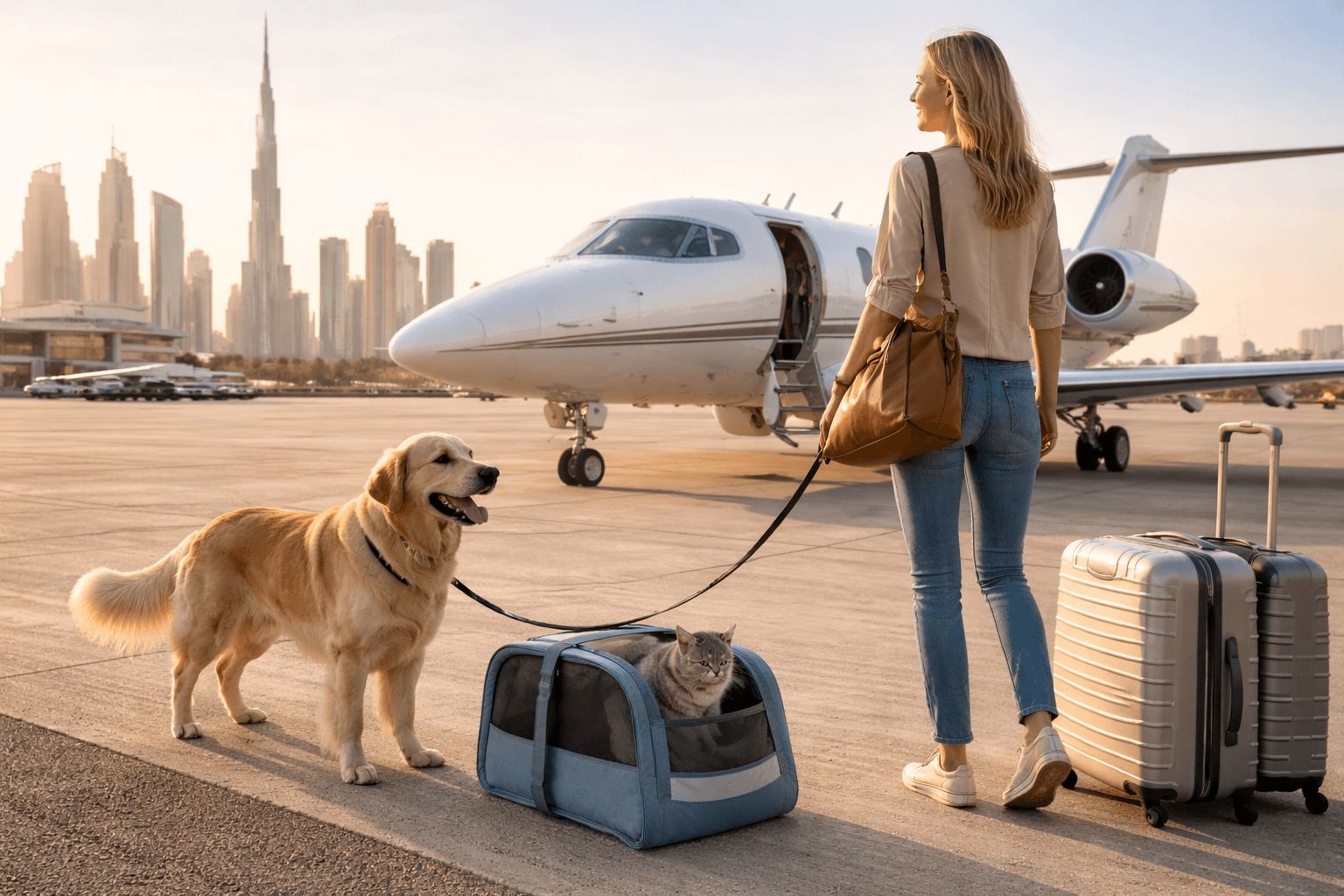
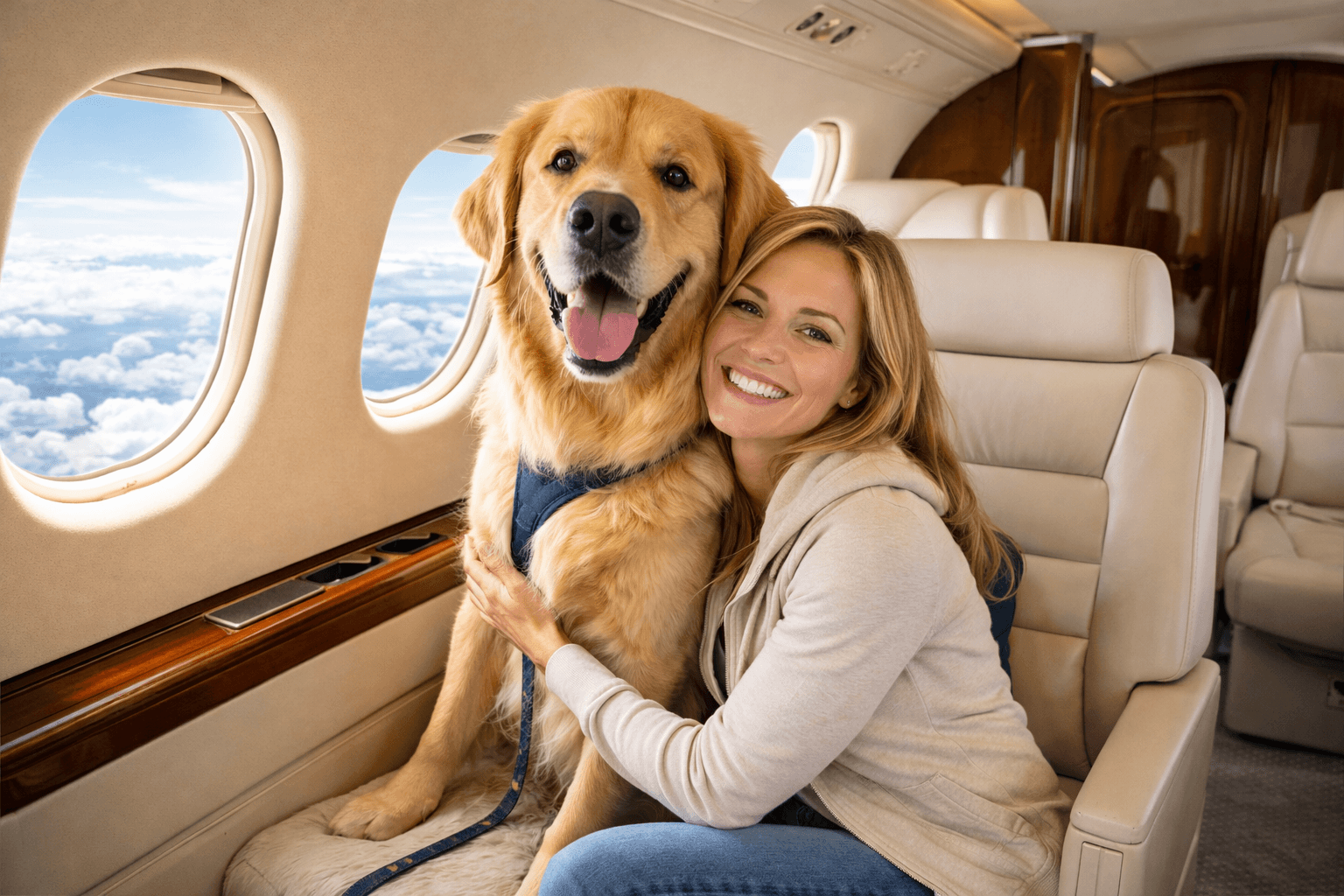
Shared Charter Flights (Where Large Dogs Can Fly in Cabin)
This is what most people searching for “big dog friendly airlines” are actually looking for.
Shared charter operators allow:
- Large dogs in cabin
- No under-seat carrier restriction
- Dogs at your feet
- Breed flexibility (with some operator limits)
These flights are now common on:
- U.S. ↔ UK
- U.S. ↔ EU
- UK ↔ Europe
- UK/EU ↔ Asia
- Select Middle East routes
Pricing is premium. But demand has grown rapidly because commercial airlines remain restrictive.
If your priority is:
- Avoiding cargo
- Minimizing stress
- Keeping your dog physically beside you
Shared charter is often the only in-cabin solution for large dogs.
The Paws Abroad flight marketplace is live and built specifically for pet parents who need to see real options for large dogs.
Inside the marketplace you can:
- search routes and see pet‑relevant flight options.
- compare commercial, semi‑private, shared charter, and full charter choices.
- filter for routes that realistically work for dogs that are too big for cabin carriers.
Start in the marketplace to see what’s realistic for your route, then choose the Paws Abroad service level that fits your budget and how much help you want. If you need help using the marketplace or have questions about support for your route, contact us at info@pawsabroad.co.
Semi-Private Airlines (Mostly U.S.)
Some U.S.-based semi-private operators allow larger dogs with the purchase of an additional seat.
These are:
- Mostly domestic
- Limited route networks
- Not global relocation solutions
But they can work for certain U.S. moves.
Is Any Commercial Airline Changing the Rules?
Italy’s aviation authority (ENAC) has begun testing demonstration flights allowing dogs up to 25 kg in cabin under specific compliance structures.
This could influence EU policy long-term.
But as of 2026, no major commercial airline has adopted permanent large-dog cabin policies.
Service Dogs (Important Clarification)
Under current U.S. DOT regulations:
- Only trained service dogs qualify.
- Emotional Support Animals (ESAs) are treated as pets.
- Documentation is required.
- The dog must fit within the handler’s floor space.
International rules vary significantly.
This is not a workaround for large dogs.
So What’s the Best Airline for Large Dogs?
There isn’t one universal “best airline for large dogs.”
There is:
- Best aircraft type
- Best season
- Best routing
- Best handling strategy
- Best legal compliance sequence
That’s why we built Paws Abroad.
Because flying with a large dog isn’t about finding one magical airline.
It’s about building the right plan.
Frequently Asked Questions About Flying With a Large Dog (2026)
Can large dogs fly in the cabin on commercial airlines?
In almost all cases, no.
Most commercial airlines limit in-cabin pets to small dogs that fit in an under-seat carrier, typically under 8–10 kg (17–22 lbs) including the carrier.
If your dog weighs more than that, they usually must travel via cargo, semi-private flight, shared charter, or private charter.
What airline allows large dogs in cabin?
No major commercial airline consistently allows large dogs in the cabin under standard pet policies.
Some semi-private airlines (primarily in the U.S.) and shared charter operators allow larger dogs in cabin — often with an additional seat purchase or full shared charter booking.
Availability depends heavily on route, aircraft type, and operator policies.
Are there any pet-friendly airlines for large dogs?
Many airlines are “pet-friendly” but that usually applies only to small dogs.
If you are looking specifically for pet-friendly airlines for large dogs in cabin, your realistic options are:
- Shared private charter flights
- Certain semi-private U.S. operators
- Full private jet charter
For most international routes, commercial airlines require large dogs to travel as cargo.
What airlines will fly large dogs internationally?
Many airlines will transport large dogs internationally but typically via cargo or manifest cargo, not in the cabin.
Some countries (such as the UK and Australia) require pets to arrive via approved cargo procedures.
Shared charter is an alternative for select international corridors, especially U.S. ↔ UK/EU routes.
Is cargo safe for large dogs?
When properly planned, cargo can be very safe.
Modern aircraft used for pet transport:
- Are pressurized
- Maintain controlled temperature ranges
- Use designated live animal compartments
- Follow IATA Live Animal Regulations (LAR)
The greatest risk is not during flight it’s during ground handling in extreme temperatures. That’s why airlines impose seasonal heat and cold embargoes.
Choosing the right route, season, and crate setup significantly reduces risk.
How do large dogs usually fly on airplanes?
Large dogs typically travel one of four ways:
- Cargo (excess baggage or manifest cargo)
- Shared charter flights (in cabin)
- Semi-private airlines (mostly U.S. domestic)
- Full private charter
The best method depends on your dog’s size, breed, route, and comfort level.
How much does it cost to fly a large dog?
Costs vary widely:
- Commercial cargo: $500–$3,000+ depending on route and size
- Shared charter: $4,000–$12,000+ per seat depending on corridor
- Semi-private (U.S.): $1,000–$3,000+
- Full private charter: $10,000–$120,000+
International documentation and veterinary requirements are additional.
Can my 40 lb / 50 lb / 60 lb dog fly in cabin?
On traditional commercial airlines, no.
Dogs of that size will not fit under standard under-seat carrier rules.
For dogs in this weight range, shared charter or semi-private flights (if available on your route) are typically the only in-cabin options.
Are emotional support animals allowed in cabin for large dogs?
In the United States, emotional support animals (ESAs) are treated as pets under current DOT regulations.
Only trained service dogs qualify for protected in-cabin access.
International rules vary, but ESAs are generally not recognized.
What is the best airline for large dogs?
There is no single “best airline” for large dogs.
The best option depends on:
- Your route
- Destination import rules
- Time of year
- Your dog’s size and breed
- Your comfort level with cargo vs charter
For some families, cargo is perfectly appropriate.
For others, shared charter is worth the premium.
Do large dogs have to travel in cargo internationally?
In many cases, yes.
Some countries legally require pets to arrive as manifest cargo, regardless of airline cabin policies.
Even if an airline allowed cabin travel, destination regulations may override it.
Always confirm destination requirements before booking flights.
How do I find flights that allow large dogs?
This is where planning matters.
You need to confirm:
- Airline pet policy
- Aircraft type
- Route restrictions
- Temperature embargoes
- Destination import requirements
Check out the Paws Abroad Flight Marketplace to compare pet-friendly commercial and shared charter flights by route.
Can large dogs fly on private airlines or private jets?
Yes. Private airlines and charter flights are currently the most flexible way for large dogs to fly in the cabin.
Unlike commercial airlines, private aircraft do not require pets to fit under an airline seat. Large dogs can typically sit at your feet or beside you, depending on aircraft size and operator policies.
There are three main categories:
- Shared charter flights (multiple families sharing a pet-friendly aircraft)
- Semi-private airlines (mostly U.S. domestic routes)
- Full private jet charter (exclusive aircraft rental)
Private aviation does not remove import or export documentation requirements your dog still needs the correct microchip, vaccinations, and destination paperwork.
If you’re considering this route, read our full guide here:
Charter Air Travel With Pets Guide
Or reach out directly at info@pawsabroad.co if you’d like help evaluating shared charter options.
How much does it cost to fly a large dog on a private jet?
Private jet and charter pricing varies significantly by route and aircraft type.
Typical ranges:
- Shared charter: $4,000–$12,000 per seat (U.S. ↔ UK/EU common corridors)
- Semi-private (U.S. domestic): $1,000–$3,000+
- Full private charter: $10,000–$120,000+ depending on route distance and aircraft size
Costs are influenced by:
- Aircraft type (light jet vs heavy jet)
- International permits
- Landing fees
- Route distance
- Seasonal demand
What To Do Next
Ready to stop guessing and get your route mapped?
Book a Route Review Call $150, up to 1 hour. We’ll look at your dog’s size, your route, the compliance requirements, and the realistic flight options available to you. If you move forward with Guided or White-Glove Concierge, the $150 is credited.
Flying with a large dog is absolutely possible. It just requires the right plan.
Discussion
Join the conversation
Share your experiences or ask questions about this article.