Airline Pet Policies for International Travel (2026): What’s Allowed, What’s Changed, and How to Choose Safely
 Marisa Hoskins14 min read
Airline pet policies are one of the most confusing parts of international pet travel in 2026 because they are not governed by a single set of rules.
Airline pet policies change based on the airline, route, aircraft, season, and your pet’s size and breed. Even if your pet meets your destination country’s entry requirements, an airline can still deny travel based on operational or safety rules.
Airline pet policies refer to the rules airlines use to determine whether, how, and under what conditions pets are allowed to travel on a specific flight.
This guide breaks down how airline pet policies work in 2026, what the biggest changes are, which airlines still offer general-public cargo options, and how to choose the safest, most realistic route for your pet.
If you want help choosing the right airline, route, and travel method for your pet, Paws Abroad can help you turn the rules into a real plan. Use our flight checker to compare eligible options, or choose a Paws Abroad service based on how much support your route needs.
Helpful resources to start with:
- International Pet Travel Requirements Hub
- Pet Health Certificate Guide
- FAVN / Rabies Titer Test Guide
- Summer Pet Travel Restrictions / Airline Embargoes Guide
- Paws Abroad Membership
- Airlines That Allow Large Dogs In Cabin
- My Dog Is Too Big To Fly
- 2026 Pet Friendly Airline Guide
Quick answer: Can pets fly internationally in 2026?
Yes but the method depends on:
- Destination rules (example: pets entering the UK must arrive as manifest cargo, except assistance dogs)
- Airline rules (some airlines do not allow pets in the hold for the general public)
- Pet size (in-cabin is typically limited to small pets)
- Breed restrictions (especially brachycephalic / snub-nosed breeds)
- Season + temperature embargoes (summer heat restrictions are one of the biggest reasons pets get denied last-minute)
If you want a shortcut: the most important thing to figure out early is which of the 3 airline pet travel categories your pet realistically fits into.
The 3 types of airline pet travel (and why this matters)
These three categories determine which airlines you can use, how much you’ll pay, and whether professional booking access is required.
1) In-cabin pet travel (PETC)
Your pet travels under the seat in front of you in an airline-approved carrier.
Typically works best for:
- small dogs or cats that can fit comfortably in a carrier under the seat
- straightforward routes where the destination allows in-cabin imports
Common limitations:
- strict carrier sizing rules
- limited number of in-cabin pets allowed per flight
- route bans (many airlines restrict in-cabin pets on certain destinations)
2) Checked baggage / “in the hold” (AVIH)
Your pet travels in a climate-controlled hold on the same flight as you, checked in at the airport.
Important 2026 trend: This option has tightened significantly for the general public on several major carriers.
3) Manifest cargo (air waybill / cargo shipment)
Your pet travels as manifest cargo (often requires cargo booking processes, and sometimes a pet shipper depending on airline/route).
Typically required for:
- pets entering the UK
- larger pets exceeding checked baggage limits
- certain countries that require cargo-only entry
- routes where airlines only accept pets via cargo partners or cargo departments
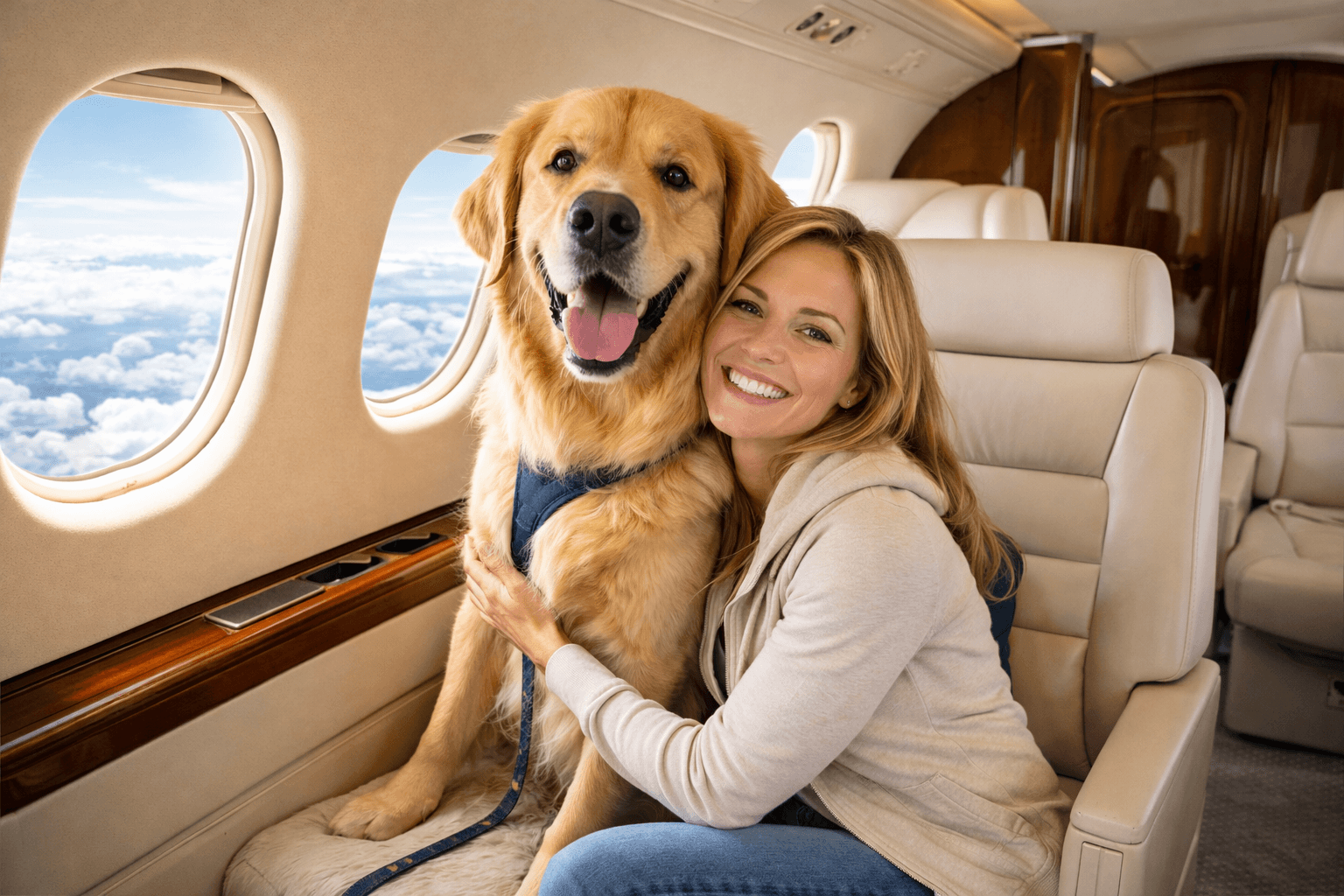
Many pet travellers are opting to fly via private jet to allow their pets, even large or brachycephalic dog breeds, to travel in cabin. If you are considering flying private or shared charter with your pets, check out our Charter Air Travel With Pets guide for more information.
Not sure which option fits your route?
Start with the flight checker, then choose the right Paws Abroad service for route-specific planning, timeline guidance, and airline validation.
What changed in 2026 (the stuff that’s catching people off guard)
Here are the big structural shifts that matter most for pet parents planning 2026 travel:
1) Checked-baggage / cargo access tightened for the general public
- United and Delta now restrict pet transport in the hold/cargo to active U.S. military and U.S. State Department / Foreign Service personnel only (with narrow exceptions and route limitations).
- American restricts checked pets to military/FSO but still offers general-public cargo via PetEmbark on many routes.
- British Airways: pets are cargo-only (except recognized assistance dogs).
2) Brachycephalic (“snub-nosed”) breeds are increasingly blocked
Across many carriers, brachycephalic dogs/cats are:
- refused in the hold, and sometimes refused entirely depending on the airline and travel class
- sometimes allowed in cabin only if they meet size/carrier limits
- sometimes allowed cargo-only under stricter rules (larger crate, cooler temps, seasonal limits)
3) Regulations override airline policies on specific routes
Two big ones that shape airline feasibility:
- United Kingdom inbound: pets entering Great Britain must arrive as manifest cargo (assistance dogs are the exception).
- U.S. CDC dog import rules (effective Aug 2024): airlines may require the CDC Dog Import Form and enforce age/microchip conditions depending on where your dog has been in the last 6 months.
Europe travel requirements
Airline feasibility + EU entry rules for traveling with a dog in 2026.
→ Explore the Europe Dog Travel Guide
If you’re unsure which rules apply to you, start with:
- International Pet Travel Requirements Hub
- Or get a personalized travel plan inside Paws Abroad
Step-by-step: How to choose an airline for your pet (without getting blindsided)
Step 1: Start with destination rules (not the airline)
Before you compare airlines, confirm whether your destination allows:
- in-cabin entry
- checked baggage entry
- cargo-only entry
Start here:
Step 2: Identify your pet’s realistic travel category
- Small pet (potential in-cabin)
- Medium/large pet (likely hold or cargo)
- Brachycephalic breed (expect restrictions; may change your route entirely)
Step 3: Filter out airlines that won’t work for your travel type
Example:
- If you need general-public cargo on a major U.S. carrier, Delta/United are usually not your path.
- If you’re flying into the UK with a non-assistance pet, you’re planning for manifest cargo, period.
Step 4: Check aircraft + seasonal risk
Even within the same airline:
- some aircraft types have restrictions
- summer heat embargoes can override “normal policy”
- last-minute aircraft swaps can change eligibility
| Airline | Cabin Allowed? | Max Weight (Cabin) | Cabin Fee (One-Way) | Cargo / Hold Available? | Summer Embargo? | Brachycephalic Restrictions |
|---|---|---|---|---|---|---|
| Air Canada | ✅ Yes | 10 kg / 22 lbs (pet + carrier) | $105–$120 CAD/USD | ✅ Yes (up to 45 kg) | Yes (seasonal) | Partial |
| United Airlines | ✅ Yes | No specific weight; must fit in carrier | $150 USD | ❌ No (PetSafe suspended; military/gov only) | Yes (May–Sep routes) | Yes |
| Delta Air Lines | ✅ Yes | No published weight; carrier must fit under seat | $150 USD (domestic) $200 USD (international) |
❌ No (military/state dept only) | Yes (varies by route) | Partial (route-specific) |
| American Airlines | ✅ Yes | 20 lbs / 9 kg (pet + carrier) | $150 USD | ✅ Yes (PetEmbark cargo; military priority) | Yes (seasonal routes) | Varies by route |
| Lufthansa | ✅ Yes | 8 kg / 17.6 lbs (pet + carrier) | €55–€110 (short/med haul) €150–€190 (long haul) |
✅ Yes (cargo & hold) | Yes (seasonal) | Yes |
| Air France / KLM | Yes | 8 kg / 17.6 lbs (pet + carrier) | Varies by route | Yes (hold up to 75 kg total) | Yes (seasonal) | Yes |
| British Airways | ❌ No (assistance dogs only) | N/A | N/A | Yes (IAG Cargo only) | N/A | N/A |
| WestJet | ✅ Yes | No published weight; carrier must fit under seat | $50–$59 CAD/USD (North America) $100–$118 CAD/USD (international) |
✅ Yes (checked baggage up to 100 lbs) | Yes (temperature-based) | Not specified |
Choose the Right Paws Abroad Service
Start with the flight search to see what options are available for your route, then choose the Paws Abroad service that matches the level of support you need.
- DIY Pet Travel Plan: best for simpler routes when you want the essentials and prefer to manage the details yourself.
- Guided Pet Travel Concierge: best when you want route-specific planning, timeline guidance, and airline validation with expert support.
- White-Glove Pet Relocation Concierge: best for complex, urgent, or high-stakes relocations where you want hands-on support from start to finish.
If your route includes the UK, EU, Asia, a large dog, multiple pets, or a brachycephalic breed, the Guided or White-Glove options are often the safest choice.
Airline-by-airline pet policies (2026): What matters for real planning
Air Canada pet policy (international)
Best for: pet parents who need multiple options (cabin + checked + cargo) depending on route.
- In-cabin: cats/small dogs, pet + carrier up to 10 kg; soft-sided carriers only (effective June 1, 2025).
- Checked baggage: cats/dogs on many routes, up to 45 kg incl. crate (route exclusions apply).
- Cargo: AC Animals via Air Canada Cargo available to the general public.
- Breed: snub-nosed restrictions for hold/cargo are common; seasonal temperature embargoes apply.
Related reading:
United Airlines pet policy (international)
Reality check: United is primarily an in-cabin-only airline for the general public in 2025–2026.
- In-cabin: cats/dogs that fit under the seat.
- Checked/cargo for public: not available (military/FSO only, with narrow program constraints).
- Breed: strict exclusions for brachycephalic/strong-jawed breeds in military cargo.
If you have a medium/large dog and were assuming United cargo is an option this is one of the most common planning mistakes we see.
Delta Airlines pet policy (international)
Reality check: Delta is also primarily in-cabin-only for the general public right now.
- In-cabin: cats/dogs on many routes, but destination bans apply (UK, AU/NZ, etc.).
- Checked/cargo for public: not available (military/FSO only).
- Breed: brachycephalics not accepted in cargo even under exceptions.
American Airlines pet policy (international)
American can be viable depending on where you’re going and your pet size but it’s important to understand the split:
- In-cabin: allowed on many regional international routes (not transatlantic).
- Checked baggage: military/FSO only.
- Cargo: PetEmbark cargo can be an option for the general public on eligible routes.
- Breed: exclusions exist for brachycephalic and restricted breeds.
Lufthansa pet policy (international)
Lufthansa is often one of the more workable options for international pet travel if your pet fits their structure.
- In-cabin: cats/dogs up to 8 kg including carrier.
- Hold: available for eligible cats/dogs on many routes.
- Cargo: Lufthansa Cargo for larger, unaccompanied, or restricted cases.
- Brachycephalic: not allowed in passenger hold (cabin if small enough, otherwise cargo with restrictions).
KLM pet policy (international)
KLM can be workable but aircraft type and UK routing rules matter.
- In-cabin: small cats/dogs up to 8 kg (Economy on many routes; Business limited).
- Hold: available with aircraft restrictions and connection limits.
- UK inbound: pets must go as cargo.
- Brachycephalic: many breeds banned in hold.
Air France pet policy (international)
Air France is similar to KLM in structure (and shares cargo networks).
- In-cabin: cats/dogs up to 8 kg.
- Hold: 8–75 kg incl. crate (route/aircraft limits apply).
- Brachycephalic: prohibited in the hold (cabin if small enough, otherwise cargo where permitted).
British Airways pet policy (international)
If you’re using British Airways and your pet is not a recognized assistance dog, this is the rule of thumb:
- Cabin: assistance dogs only.
- Checked baggage: not offered for pets.
- Cargo: all pets travel via IAG Cargo partners.
For UK-bound routes, this aligns with the broader UK inbound reality: manifest cargo for non-assistance animals.
Qatar Airways pet policy (international)
Qatar is a common relocation-pathway airline but it’s not a “pets in cabin” carrier for dogs/cats.
- Cabin: service dogs (and falcons on certain routes per policy).
- Checked baggage: dogs/cats can be accepted on many routes (within limits).
- Cargo: Qatar Cargo is a major pathway for international pet shipments.
- Breed/temperature: strict snub-nosed and temperature rules apply.
Emirates pet policy (international)
Emirates is another major relocation carrier (especially via Dubai), but pets are generally not in-cabin.
- Cabin: service dogs on limited routes; falcons on limited routes.
- Hold as excess baggage: available on some itineraries (route constraints apply).
- Cargo: Emirates SkyCargo “Pet” solution is widely used.
- Breed: some brachycephalic breeds are banned outright; others heavily restricted seasonally.
For details on the Tap Airline Pet Policy check out our Tap Air Portugal 2026 Pet Travel Guide
Common restrictions that cause denied boarding (and how to avoid them)
1) UK inbound reality
If your pet is entering Great Britain:
- pets must arrive as manifest cargo
- cabin/checked baggage does not apply (assistance dogs are the exception)
2) CDC dog import rules into the U.S.
Airlines may require:
- CDC Dog Import Form
- age/microchip alignment rules
- additional requirements depending on high-risk rabies country exposure
3) Temperature embargoes
Pets can be refused due to heat/cold forecasts at:
- departure airport
- layover airport
- destination airport
For a detailed breakdown:
4) Brachycephalic restrictions
Snub-nosed dogs/cats face higher risk in holds, so many airlines:
- ban them in hold entirely
- allow cabin only (if small enough)
- enforce cooler temperature thresholds
- require larger crate sizes when accepted
Flying to Europe with your dog?
Airline rules are only half the picture. EU entry requirements determine whether your dog can actually enter on arrival.
→ See the Europe Dog Travel Guide (2026)
How Paws Abroad Helps
Most pet parents do not need more policy pages they need the right next step for their route.
Paws Abroad helps you:
- compare pet-friendly flight options.
- choose the right level of service for your route.
- build a travel plan around destination rules and airline restrictions.
- get concierge support when the route is more complex.
If your route is straightforward, a lighter Paws Abroad service may be enough. If your route is more complex, concierge support gives you hands-on help from planning through booking.
When Airline Pet Policies Aren’t Enough
Understanding airline pet policies is an important part of planning international pet travel. However, airline rules are only one piece of the process.
Even when airlines technically allow pets on a route, other factors can complicate travel, including:
- limited cargo capacity
- seasonal temperature restrictions
- documentation timing requirements
- sudden flight schedule changes
In situations where airline cargo services are unavailable or unsuitable — particularly for larger dogs — some families explore shared charter flights or private aviation options so pets can travel in the cabin with their owners.
This has become increasingly relevant in global expat hubs where relocations sometimes happen quickly.
For example, families relocating from the UAE often need to coordinate both airline policies and export documentation requirements.
If you are planning to travel from Dubai with a pet, our detailed guide explains the process.
→ Leaving Dubai With a Dog or Cat (2026 Guide)
FAQs about airline pet policies (2025–2026)
Do all airlines allow pets on international flights?
No. Some airlines allow pets only in cabin, some only in hold/cargo, and some routes are restricted regardless of airline policy.
Are airline pet policies the same year-round?
No. Seasonal temperature embargoes and route-specific limitations change availability throughout the year.
Can an airline deny my pet even if I “already got approval”?
Yes. Pets may be denied due to:
- aircraft swaps
- temperature embargoes
- capacity limits (too many pets already booked)
- documentation issues discovered at check-in
Is cargo safe for pets?
Cargo can be safe when properly managed, but it depends on:
- the airline’s live-animal processes
- route length and layovers
- season/temperature risk
- your pet’s breed, age, and health profile
Do airline pet policies override country import requirements?
No, they operate separately. You must meet both.
Why can’t pets fly in cabin into the UK?
Because UK inbound rules require pets to arrive as manifest cargo (except recognized assistance dogs).
What airlines still offer general-public cargo options in 2026?
This varies by route and region, but in general:
- some airlines route cargo via dedicated cargo divisions or partners (ex: Air Canada Cargo, Lufthansa Cargo, AF/KLM Cargo, Emirates SkyCargo, Qatar Cargo, American PetEmbark)
If my dog is too big for cabin, do I automatically need a pet shipping company?
Not always but you may need cargo booking pathways depending on:
- airline policy
- your route (UK is cargo-only inbound)
- your pet’s size/breed
- whether the airline allows direct public booking for cargo or requires cargo accounts/partners
The safest way to plan airline pet travel in 2026 is to start with destination rules, then confirm which travel method your pet can realistically use, then choose the Paws Abroad service or flight option that fits your route.
If you want a faster path, start with the flight checker and move into a higher-level Paws Abroad service when your route needs more support.
Discussion
Join the conversation
Share your experiences or ask questions about this article.